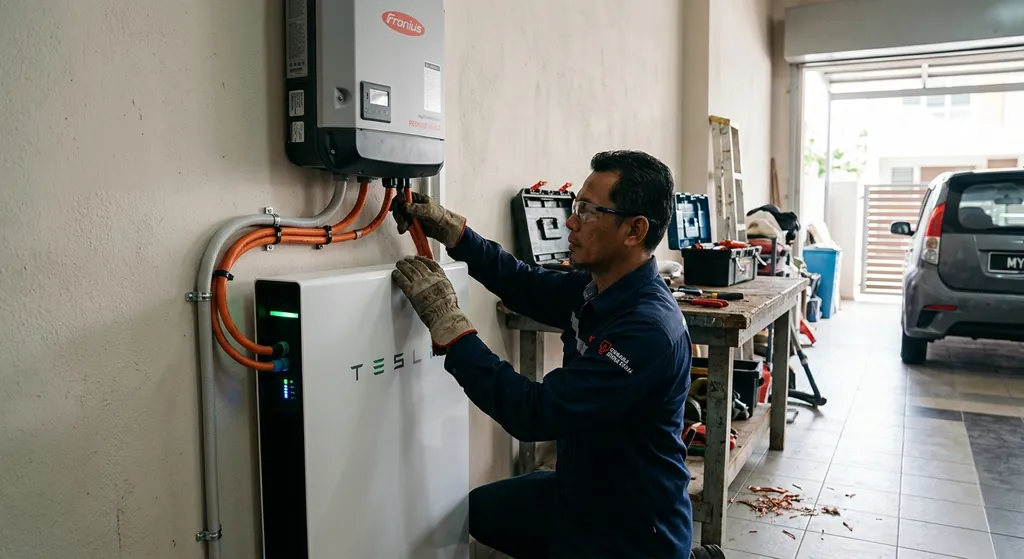
A solar battery stores the power your panels make in the day so you can use it at night or in a blackout. It makes sense if your power goes out often or most of your use is at night. Otherwise an on-grid system pays back sooner.
What Solar Battery Storage Does
Solar panels make the most power around midday. Most homes use the most power in the evening. A battery moves energy from one to the other.
It also keeps part of the home running when the grid goes down. An on-grid system without a battery switches off in a blackout.
How a Battery Fits Into the System
A battery needs a hybrid inverter. In the day, the panels run the home first and then charge the battery. When the battery is full, the rest goes to the grid.
In the evening the home draws from the battery. When the battery is empty, the home draws from TNB as usual.
Our guide to on-grid, hybrid and off-grid systems compares the three layouts.
Why Batteries Matter More Under Solar ATAP
Under Solar ATAP, exported power earns a credit against the energy charge of the same month. Unused credits do not carry over.
Power you use yourself is worth more than power you export. A battery lets you use more of your own power, because it holds the midday surplus for the night.
That is the case for a battery. The case against is the price.
What a Battery Costs
Battery storage from SolarKita starts at RM25,000. A complete hybrid system costs RM30,000 to RM60,000, against RM15,000 to RM40,000 for on-grid.
We estimate payback at six to eight years for a hybrid system and four to six for on-grid.

When a Battery Makes Sense
- Your power goes out often
- You have equipment that must stay on, such as medical devices
- Most of your electricity use is at night
- You want to rely less on the grid and accept a longer payback
When It Does Not
- Blackouts are rare where you live
- Your main aim is the lowest bill for the lowest cost
- Someone is home in the day and uses the solar power directly
- Your budget is tight
How Big a Battery Do You Need?
Battery size is measured in kilowatt-hours (kWh). Look at what you use between sunset and sunrise.
If your home uses 10 kWh in that time, a battery with 10 kWh of usable capacity covers a typical night. For backup only, add up the things you want to keep running and for how long.
A battery that is too big never fills. One that is too small empties early in the evening. We size it from your bill and your habits.
What to Ask Before You Buy
- What is the usable capacity in kWh?
- How long is the warranty, in years and in charge cycles?
- Which circuits stay on in a blackout?
- Does it switch over by itself when the grid fails?
- Where will it be installed, and does it need ventilation?
You Can Add It Later
You do not have to decide today. Start with an on-grid system on a hybrid inverter. It is ready for a battery, and you can add one when your needs change.
Our Premium Max package comes with a hybrid inverter that is battery ready. See the packages.
Sarawak Is Different
Sarawak's NEM scheme is for solar without battery storage. If you live there, read our page on solar in Sarawak first.
Ask About a Battery for Your Home
WhatsApp SolarKita with your TNB bill. Tell us how often your power goes out, and we will say plainly whether a battery is worth it.
Frequently Asked Questions
Is a solar battery worth it in Malaysia?
It is if your power goes out often or most of your use is at night. If neither applies, an on-grid system without a battery pays back sooner.
How much does solar battery storage cost?
Battery storage from SolarKita starts at RM25,000. A complete hybrid system costs RM30,000 to RM60,000, depending on its size.
Does a solar battery work during a blackout?
Yes. A hybrid system with a battery keeps the chosen circuits running when the grid is down. An on-grid system without a battery switches off.
Can I add a battery to my existing solar system?
Yes, if the system has a hybrid inverter. If it has a grid-tied inverter, the inverter has to be changed or a second one added.
How long does a solar battery last?
A battery wears out before the panels do. Check the warranty, which is stated in years and in charge cycles.
Related Reading
Ready for Solar Panels?
Get a free consultation and personalized quote for your home. We handle everything from the Solar ATAP application to installation.
Get Free Consultation